 Skip to content
Chimney Crown Repair and Replacement in Indianapolis
A chimney crown is the slab across the top of a masonry chimney. Its only job is to throw water off the structure before the brick underneath can absorb it. When a crown cracks, water stops running off and starts running in, and in central Indiana it then freezes. Water expands about nine percent as it turns to ice, so every freeze and thaw cycle pries the crack wider. A crown problem rarely stays a crown problem for long.
Clean Sweep 317 has repaired, resealed, and rebuilt chimney crowns across Indianapolis since 2014, on postwar ranches in Lawrence and on the older masonry in Meridian Hills, Williams Creek, Meridian-Kessler, Broad Ripple, and around Geist. Our technicians hold NFI certification and National Chimney Sweep Guild credentials on the chimney and fireplace side of this work, including Accredited Certified Chimney Professional and Certified Chimney Reliner. The masonry is hands on experience built up job by job since 2014. We are A+ accredited by the Better Business Bureau and average 4.9 stars across more than 795 Google reviews.
Call 317-643-1128 or request an appointment online.
Features of a Well-Built Chimney Crown
It helps to know what a crown is supposed to look like, because many of the crowns we inspect were never built correctly in the first place. Those fail early no matter how mild the weather has been.
Four details separate a crown that lasts decades from one cracked through in under ten years.
A Downward Slope
A crown should slope from the flue tile out toward the edges so water is shed rather than held. Flat crowns pond, and standing water finds every hairline crack and freezes inside it. Slope is the cheapest thing to get right and the most common thing we find missing.
An Overhanging Drip Edge
The crown should project past the face of the chimney by an inch or more, with an undercut lip so water drops clear instead of tracking back down the brick. Without it, every rain runs straight down an absorbent surface. That is how spalled brick and washed out mortar joints start.
Portland Cement, Not Mortar
Older crowns were often finished with the same mortar used to lay the brick. Mortar is deliberately softer than brick so the joints absorb movement, which makes it a poor material for a horizontal surface out in the weather. A crown should be cast from a Portland cement based mix.
Enough Thickness
At its thinnest point, out at the edge, a crown should still be at least two inches deep. Thinner than that and it cracks under its own thermal movement long before anything else wears out.
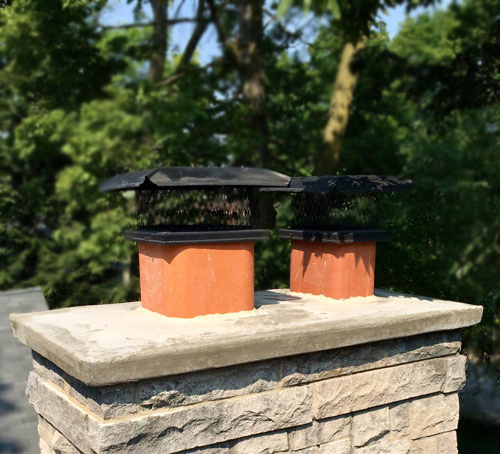
The parts around the crown matter as much as the crown. The flue tile should stand at least two inches proud of the finished surface so exhaust clears the slab instead of washing across it, and a correctly sized cap should sit over that opening to keep rain, snow, and animals out of the flue.
There should also be a bond break between the crown and the flue tile. The two materials expand at different rates, and a crown poured tight against the tile will crack along that seam within a few seasons. That one detail explains a large share of the cracked crowns we see.
Seal, Rebuild, or Cover: How We Decide
Crown work is really three different jobs, and the difference between them is worth understanding before anyone quotes you.
- Crown sealing. For hairline cracks in a crown that is otherwise sound, sloped, and thick enough. A flexible waterproof membrane bridges the cracks and moves with the slab. This buys years, not decades, and it is only honest when the crown underneath is worth saving.
- A full crown rebuild. The right call when the crown is spalling, when pieces are missing, when cracks run all the way through, or when the original was poured flat, thin, or hard against the flue tile. We take the old crown off and rebuild it with proper slope, overhang, and thickness, and set a bond break at the tile.
- A chase cover. A factory built chimney inside a framed chase has no masonry crown at all. The top is a metal chase cover, and a cover that is rusting or holding water gets replaced rather than repaired.
We will tell you which of the three you need after we look at it, including when sealing is the wrong answer even though it is cheaper. A crown that is already failing structurally does not get better under a coating.
What Crown Work Costs in Indianapolis
Crown work is quoted after an inspection, because height, access, crown size, and the condition of the masonry below all move the number. These are the ranges most Indianapolis jobs land in.
| Crown work | Typical Indianapolis range |
|---|---|
| Full crown rebuild | $1,900 to $3,000 |
| Tuckpointing to repair joints damaged by crown runoff | $700 to $2,000+ |
| Crown sealing, cap work, and chase cover replacement | Quoted after inspection |
These are educational ranges, not quotes. If a crown has leaked long enough, repairing what sits underneath it usually costs more than the crown, which is the argument for catching it early.
Consider Switching to a Chimney Chase Cover
Trading a slab of concrete for a sheet of metal sounds like a downgrade until you look at how each one fails. Concrete is rigid and porous, so it cracks and then it drinks. Stainless steel does not absorb water at all, and a cover is fabricated to fit your chase with a cross break so water runs off rather than standing on it.
The stainless chase covers we fabricate and fit carry a lifetime warranty when professionally installed by our crew. If you want the top of the chimney to be something you stop thinking about, this is how.
Chimney Crown Questions From Indianapolis Homeowners
How long should a chimney crown last?
A crown built with slope, an overhang, adequate thickness, and a bond break at the flue tile should last decades in central Indiana. One poured flat and tight against the tile can be cracked through in well under ten years. Build quality matters far more than age.
Can I seal a cracked chimney crown myself?
Sealants sold for this exist, and on a sound crown they are not useless. The problem is that from the ground you cannot tell whether the cracks are surface level or full depth, and coating a crown that has already failed traps the problem instead of fixing it. It also puts you on a roof.
What is the difference between a chimney crown and a chimney cap?
The crown is the slab covering the top of the masonry, which sheds water off the structure. The cap is the metal hood over the flue opening, which keeps rain, snow, birds, and animals out of the flue. Two different parts, two different jobs, and a chimney needs both.
Can a cracked crown damage the chimney liner?
It can. Water that gets past a failed crown runs down between the flue tile and the surrounding masonry, and repeated freezing in that gap cracks and shifts the tiles. A camera inspection settles whether the liner has been damaged. When relining is the answer we install stainless steel liners, and the stainless we install carries a transferable lifetime warranty.
Do you repair crowns on older and historic Indianapolis homes?
Yes, and older chimneys are a large share of what we do in Meridian Hills, Williams Creek, Meridian-Kessler, and Broad Ripple. On a period chimney the rebuild has to respect what is under it, which means matching the mortar to the original rather than using a modern high strength mix that would be harder than the surrounding brick. If your home sits in a regulated historic district, we will tell you before work starts and help you through the approval process.
Not Sure Whether It Is the Crown? Start With an Inspection
Most crown repairs we do started as a ceiling stain, a damp smell in the firebox, or a piece of concrete found in the driveway after a storm. Any of those is worth a look. Our general inspection covers the crown, the cap, the flashing, the mortar joints, and the flue, and when water is the complaint it is a free inspection for chimney leaks, with a free water test added when a test is what it takes to pinpoint the source.
That test is how we separate a crown leak from a flashing leak from a masonry face that is simply absorbing water, and it is why we can tell you what is actually wrong instead of selling the repair we happen to do most often. Whatever we fix at the top of the chimney, ask us about water repellent on the masonry below it while we are up there.
Call 317-643-1128 or request an appointment online and we will get a technician out to look at the top of your chimney.
- 317-643-1128
- 5351 N Tacoma Ave, Indianapolis, IN 46220
- 10 S 9th St, Suite 13 Noblesville, IN 46060